Thursday, February 12, 2015

Justification for Your Paranoia

There have been some weird events with my family lately, so it's been quite a while since I've done one of these. The past few weeks have been pretty fun for security: Anthem got hacked, TurboTax shutdown due to tax fraud, and Obama announced the creation of a new cyber security agency. I'm not going to talk about any of those things though, because the mainstream news has them covered. Here, instead, are some things a little farther afield.


1) A Skeleton Key
Network monitoring software or abnormal user behavior are two ways to detect an attacker within your network, but new malware dubbed "Skeleton Key" can evade both. The malware lets an attacker log in as any user, without needing to know or change the user's password, and doesn't raise any IDS alarms.
The new malware, discovered by Dell SecureWorks, can bypass Active Directory systems that only use single-factor authentication. Skeleton Key is deployed as an in-memory patch on a victim's AD domain controllers to allow the threat actor to authenticate as any user, while legitimate users can continue to authenticate as normal. So the attacker can pose as any user, without needing to steal the user's log-in credentials, and without changing the user's password, thereby soon alerting the helpdesk to a problem when the real user cannot log in.
The Skeleton key malware allows the adversary to trivially authenticate as any user using their injected password. This can happen remotely for Webmail or VPN. This activity looks like, and is, normal end user activity, so the chances of the threat actor raising any suspicion is extremely low and this is what makes this malware particularly stealthy. Another thing that makes Skeleton Key difficult to find is that it creates no network traffic, and is therefore not going to be detected by network-based monitoring systems.
Skeleton Key does have a few key weaknesses though. For one, before an attacker can deploy it, they must already have admin access to the network. Skeleton Key's other main drawback is that it does not use any persistence methods. So it must be redeployed any time the domain controller is restarted. However, deployment of Skeleton Key does trigger domain controller replication issues that researchers say eventually required a reboot to resolve. The lack of a persistence mechanism means that a reboot would effectively kick out the malware; but it could be redeployed later using remote access malware already installed within the organization.

2) Ghosts in the Shell
From skeletons to ghosts now (because undead are a great naming scheme). On January 28th, researchers at Qualys found a vulnerability in the gethostbyname() function of glibc (the GNU C Library) that allows a buffer overflow condition in which arbitrary code may be executed. This vulnerability is referred to by the name "GHOST".

To exploit this vulnerability, all an attacker needs to do is trigger a buffer overflow by using an invalid hostname argument to an application that performs a DNS resolution. This vulnerability then enables a remote attacker to execute arbitrary code with the permissions of the user running DNS. In short, once an attacker has exploited GHOST they may be capable of taking over the system. 
This hole exists in any Linux system that was built with glibc-2.2, but was actually patched in a minor bug fix released in 2013, but was never flagged as a security issues so many stable LTS releases never received the patch. Linux systems that are liable to attack include Debian 7, RHEL 5, 6, and 7, CentOS 6 and 7, and Ubuntu 10.04 and 12.04. Fixes have been released for Red Hat, Ubuntu, CentOS, and Debian core.
After patching it, you should then reboot the system. Linux rarely needs to reboot, but since gethostbyname is called on by so many core processes, such as auditd, dbus-daem, dhclient, init, master, mysqld, rsyslogd, sshd, udevd, and xinetd, you want to make absolutely sure that all your system's running programs are using the patched code.
If that doesn't sound fun enough for you, according to Sucuri Researcher Marc-Alexandre Montpas, a version of the bug also probably affects PHP apps, including everything built on WordPress, since they also use gethostbyname().

3) Because everything needs to be smart, right?
In the last one of these I talked about cheap devices that can intercept and decrypt all of the keystrokes on your wireless keyboard. Well, now for a conceptual wireless keyboard that might actually help with your security, rather than hindering it.
In a publication for the American Chemical Society titled Personalized Keystroke Dynamics for Self-Powered Human–Machine Interfacing scientists describe a self-cleaning, self-powered smart keyboard that can identify computer users by the way they type, which they hope could help prevent unauthorized users from gaining direct access to computers.
Georgia Tech Professor Zhong Lin Wang and colleagues developed a "smart keyboard" that can sense typing patterns that can accurately distinguish one individual user from another. So even if someone knows your password, he or she cannot access your computer because that person types in a different way than you would. 
By analyzing such parameters as the force applied by key presses and the time interval between them the keyboard could provide a stronger layer of security for computer users. Every punch of the keys produces a complex electrical signal that can be recorded and analyzed. To evaluate the authentication potential of the keyboard, the research team asked 104 persons to type the word “touch” four times, and recorded the electrical patterns produced. Using signal analysis techniques, they were able to differentiate individual typing patterns with low error rates.
The self-powered device generates electricity when a user’s fingertips contact the multi-layer plastic materials that make up the device. In addition to providing a small electrical current for registering the key presses, the keyboard could also generate enough electricity to charge a small portable electronic device or power a transmitter to make the keyboard wireless. An effect known as contact electrification generates current when the user’s fingertips touch a plastic material on which a layer of electrode material has been coated. Using the triboelectric effect, a small charge can be produced whenever materials are brought into contact and then moved apart.
The new device is based on inexpensive materials that are widely used in the electronics industry. As part of the study, his research group evaluated the keyboard under challenging conditions, including application of moisture, dirt and oil. “You could pour coffee on the keyboard, and it would not be damaged,” said Wang. “Because it is based on a sheet of plastic, liquids will not hurt it.” AND the special surface coating repels dirt and grime!
But can it keep dog hair from getting stuck in the grooves between keys?.
4) A Possible Tor Replacement?
By this point, everyone paying any attention at all should know about Tor, onion routing, and the so-called deep web. If you didn't know about it a month ago, the recent trial of alleged Silk Road founder Ross Ulbricht, and the take-down of the Silk Road site should have pounded it home. Well for all you former Silk Road users looking for some libertarian economics on the net, there is a new Silk Road.
The fact that there is a new Silk Road (or even that there was an original Silk Road) does not interest me that much, what interests me is that it has been moved off of the Tor network and onto I2P. I2P (originally an acronym for "Invisible Internet Project") has been around since 2003, but was always overshadowed by Tor. 
Like Tor, I2P encapsulates and anonymizes communications over the Internet, passing Web requests and other communications through a series of proxies to conceal the location and identity of the user. Like Tor, I2P also allows for the configuration of websites called "eepsites," within the network that are concealed from the Internet at large (always with the .i2p extension) and are only reachable using the anonymizing network.
But there are some significant differences between Tor and I2P beneath the surface, from the technologies they are based on to how the networks are implemented. In many ways, I2P is a much less mature technology than Tor—but it has the potential to anonymize a greater range of applications and services as it gains adoption, and its architecture is theoretically less vulnerable to the sorts of deanonymizing attacks that have been used against Tor.
By contrast to Tor's "onion routing", I2P uses an approach jokingly called "garlic routing". The message is encrypted with a key for the end-point, and then each router along the path uses an encrypted "tunnel" to add a second layer of protection as it moves to the next—so there's always two layers of encryption on I2P traffic. And bundled in with the packaged "clove" of a message are additional encrypted handling messages: a "delivery status" message giving instructions on sending a message response to provide information on where the response of the message is to be sent and data with the sender's public key and other data needed to route back the response. Additionally, the router can bundle in other messages from other users into the same "garlic" for forwarding, making it more difficult to track an individual message in the stream.
I2P is essentially a peer-to-peer anonymizing service. All clients on the network also act as routers for I2P traffic, and there is no centralized directory server to help clients pre-build the routes for their connections. This is allows I2P to be a packet-switched network and load balance traffic across peers rather than having all the traffic from one client to an exit point follow a single path. It also allows I2P to use unidirectional tunnels—responses sent back to a request don't follow the same network path, making it more difficult to man-in-the-middle both parts of an I2P communication. The packet-based, one-way approach to connections also allows I2P to support UDP traffic—which means I2P can support a number of streaming applications. 
While this makes I2P useful for things like anonymized BitTorrent streams and the like, it does not have the scale or the level of additional protections that the Tor network provides. There are no tools to help get around state-imposed firewalls, for example, like Tor's pluggable transports and bridges. There's also not as much in the way of ready-made software and developer support for I2P as there is for Tor. But since I2P is based on Java, it is easily ported to new platforms. And as with Tor, there is a browser bundle available based on Firefox—called Abscond—for those who want a simpler way to hide themselves. (Unfortunately, it's only available for Windows.)
Of course, legally questionable marketplaces are not the only things hiding in anonymized networks. The newest version of the CryptoWall ransomware has started using I2P instead of Tor. Likewise, Popcorn Time (a BitTorrent media player) has started looking at supporting I2P anonymization.

5) Sometimes the conspiracy theories are right...
Back in July, The Official CIA Twitter account (yes the CIA uses twitter) tweeted:
"Remember reports of unusual activity in the skies in the '50s? That was us." 
The tweet, as well as a followup in December included links to a recently declassified (and as usual heavily redacted) 270 page document entitled The CIA and the U-2 Program, 1954-1974. 
The CIA has long been suspected of playing a part in one of the most elaborate hoaxes of the twentieth century; including Area 51 and the secrecy they shroud over it. At the least, the popular belief was a cover up from the public, when the government were well aware of the UFO sightings. But the policy was always one of strong denial at all cost.
“The technology that enabled U-2
pilots to operate extended periods
in reduced atmospheric pressure
would later play a major role
in the manned space program.”
In the foreword of the document released late last year, the CIA admitted the “struggle between the CIA and the US Air Force to control the U-2 and a-12 OXCART projects reveals how the manned reconnaissance program confronted problems...” in the broadest sense. But the blame is placed on the shoulders of the communist bloc at the time, cutting away at communications that were once easily accessible. The United States needed and warranted the high altitude capabilities of the U-2 aircraft; where the “Soviet radars would not be able to track aircraft flying above 65,000 feet.
Though unsuccessful, the predecessor of the U-2 was to be a “giant, almost flat-shaped airship with a blue-tinted, non-reflective coating, it would cruise at an altitude of 90,000 feet,” to demonstrate what capabilities the CIA were exploring for their aircraft at the time.
It is the section in Chapter two, entitled "U-2s, UFOs, and Operation Blue Book" that add credence to the CIA claims of responsibility. The interesting part is in the end section on page 85, where the document states that U-2 and later OXCART flights, “accounted for more than one-half of all UFO reports during the late 1950s and most of the 1960s.”
What does remain, which the document doesn’t seem to answer, is the other half of the UFO sightings that the CIA don’t take accountability for. Who is responsible for them?

Friday, February 6, 2015

Gods of Tel-Avi: Dgn and the Fish Cults

Picking up where I left off back in July, this continues the series on the crazy religions in my personal game world. Previous entries include the gods: YGO, Shed, and the Nowhere Man, and this note on the limited regional scope and power of these otherwise powerful beings.

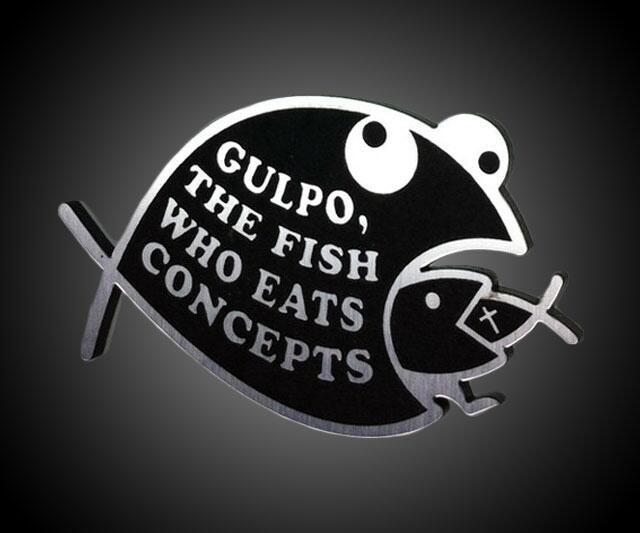
Unlike the previous three deities, which were based on music I ingested while rocking babies to sleep, Dgn and his Fish Cults are based on bumper stickers. Specifically on the fish (Ichthys) that some Christians post on their cars, the various parodies that appeared in reaction to it, and my own iconoclastic dislike of all of the above. So, take annoying fish decals, throw in some fantasy spin on a traditional semitic deity, view it all through the lens of the writings of Mercia Eliade, and you get...this...

Once again:  Yes, there is room here for people to be offended, and that's okay...

____________________________________________________________________

Next came one who mourned in earnest, 
When the captive ark maimed his brute image, 
Head and hands lopt off,
In his own temple, on the grunsel-edge,
Where he fell flat and shamed his worshipers:
Dagon his name, sea-monster, upward man
And downward fish; yet had his temple high
Reared in Azotus, dreaded through the coast.

Dgn (alternately pronounced as Dagn, Dāgôn, Dīgan, Dagnu, Dagana, Daguna, or Dagan) is the quiet and enigmatic god of the sea. He is credited as the creator of the first sentient beings in Tel-Avi and is worshiped by many as a bringer of bountiful harvests. Dgn is mostly commonly depicted as a giant half-man, half-fish, with a fish's tail and the head and torso of a bearded human male. In some cultures he is shown as a man with the head of a fish and a fish in place of (or biting onto) his phallus.

Dgn is one of the least active gods in Tel-Avi. He never speaks to mortals and refuses all forms of magical contact (such as augury or contact other plane). He never sends heralds to the material world, nor does he send visions or omens to his oracles (though this does not stop his worshipers from interpreting all sorts of piscine activity as signs from him). Dgn has more worshipers than any other god in Tel-Avi, though his lack of direct communication with those worshipers has resulted in numerous very fragmented cults in his name. His cultists generally see his non-communicativeness as a sign of his power, claiming that Dgn is so supremely powerful that mortal concerns are simply beneath his notice.

Numerous, often conflicting, stories are told about Dgn and his exploits. The most common speak of his primordial war with YGO, the god of the sky, and his creation of man (or whatever race the speaker happens to be) as soldiers in that ancient war. In some cases the story tells of Dgn's victory and his subsequent freeing of men to multiply upon the earth and pursue their purposes. The worshipers of YGO, insist that such stories are not only false, but direct inversions of the truth, claiming that YGO created the world and all that live in it and that Dgn sought to destroy YGO's creation.

The Cosmogonists support the Yigden version of the story, claiming that Dgn equates to the primordial "water dragon" and that YGO represents the creative "supreme sky god" common throughout the ancient religions they have studied. Both the Cosmogonists and the Yidden, as well as certain more violent of his Fish Cults, speak of Dgn as a great serpentine sea-monster or kraken. By such he is spoken of as the "father of monsters", creating not men but various destructive beasts. Creatures such as the sphinx, chimera, manticore, hydra, and the dreaded leviathan are spoken of as the "Children of Dgn".

Dgn's realm is the Sea. He makes his home in the great oceans of the material plane. Some claim that he rules from a castle on an island far beyond sight of any other land. Others insist that his palace floats upon the waves, as does a ship, and goes wherever Dgn commands it. Most believe that Dgn's palace instead rests beneath the waves, nestled in the dark, deep recesses of an ocean trench.

Scholars of planar cosmologies claim that Dgn is the ruler of the Elemental Plane of Water, and that any palace he may have on the material plane is simply a gate to his true fortress in the Plane of Water. From the Elemental Plane, so the scholar's say, Dgn is not limited to the oceans of the physical world, but rather rules all oceans in all realities throughout the cosmos.

____________________________________________________________________

The "Fish Cults" (as they are most commonly known by outsiders), are a collection of related, but opposed, faiths all of which claim to worship Dgn but seldom agree on his nature or statutes. Dgn is recognized by his many cults as the creator and giver of life, the ruler of the oceans and seas, and lord of fertility, fecundity, and harvests. Beyond this, none of his cults can agree. Dgn never responds to inquiry via spells such as augury, divination, or commune, and thus the discrepancies between the various faiths may never be resolved.

The Cults: There are five major branches of the Fish God's faith, each of which insists that theirs is the correct interpretation of Dgn's will, as passed down by their various prophets, priests, ministers, and theologians.
The Cult of the Fish: The traditional cult of the fish (sometimes called "Swimmers")
insists that Dgn created all life in the oceans, and that life on land is a result of the sin of the first man, Aamuh, fleeing the realm of Dgn to tread upon the earth. The Fish-Cultists insist that Dgn wants to have a renewed relationship with mankind and that all faithful men will one day return to the oceans from which they were born.
The Cult of the Walking Fish: Directly, and often violently, opposed to the Fish-Cultists, the cultists of the walking fish (commonly known as "Leggers" or "Walkers") insist that Dgn created all life (land, sea, and air) as it is, and that creatures of the land were made to walk and were not born in the sea.
The Cult of the Devouring Fish: The cultists of the devouring fish (commonly known as Devourers) worship Dgn as a deity of war and destruction, rather than as a creator deity. They see Dgn as a great shark, kraken, or sea-serpent intent on devouring all lesser creatures, and believe that the correct way to worship him is to do likewise.
The Cult of the Spawning Fish: "Spawners" emphasize the fertility aspect of Dgn to the exclusion of all else. They claim that the first man, Aamuh, was not banished from Dgn's realm beneath the waves, but was rather sent forth by Dgn to populate the otherwise barren land. They see procreation the greatest form of worship.
The Cult of the Enigmatic Piscine: A fairly recent invention, this cult believes that the Fish God deliberately refuses to give guidance to his worshipers. They claim that after creating sapient life Dgn ("if that is his real name") left men to their own devices hoping that they would discover the mysteries of the universe on their own. As such, the Enigmatics (as they are sometimes known), insist that anyone claiming to know the will of the Fish God must, by nature, be wrong.

Symbols: All the fish cultists use a simple outline of a fish as their symbol. Certain of the cults have their own unique variations on the theme. High-ranking priests of all the cults (save the Enigmatics) are identified by their hats, made to resemble a stylized fish-mouth.
The Cult of the Fish: The Swimmers use the standard fish icon as their holy symbol. It is always displayed prominently, and may be worn on shields, tabards, jewelry, or any other readily visible garment.
The Cult of the Walking Fish: The Leggers' holy symbol is only a slight variation on the base, depicting the outline of a fish with legs fore and aft, in addition to fins.
The Cult of the Devouring Fish: The Devourers' symbol depicts a large fish (with or without legs) eating a smaller fish. 
The Cult of the Spawning Fish: Spawners use a large fish followed by a school of 2 or more smaller fish as their symbol of choice.
The Cult of the Enigmatic Piscine: Enigmatics abhor all use of symbols, insisting that it is a great sin to make any depiction of their silent god. They refuse to wear any symbol, icon, or heraldry of any kind, whether it be for a deity, ruler, family, business, or other organization. They likewise avoid showing any text on their garments or arms that might be misconstrued as religious in nature. Most Enigmatics dress entirely in solid, drab colors (grays, browns, or undeyed fabrics) and eschew the use of jewelry.
Ceremonies and Statutes:
The Cult of the Fish: Swimmers believe that all lifeforms are meant to return to the sea. Members of this cult must know how to Swim.
  • Initiation: Swimmers are initiated in a short, simple ceremony involving immersion in water. The initiate and a priest swim out into a large body of water, at least twice the initiate's height in depth and at least 20 yards from land. Once there, the priest holds the initiate fully submerged under the water until the initiate passes out from lack of air. Once the initiate has so "drowned" he is brought up from the water and revived, reborn as a servant of the Fish God.
  • Dietary Restrictions: Swimmers believe that all ocean-life is sacred, as it is closer to that which the Fish God first created. Willfully killing any aquatic creature (even in self defense) is an inexcusable sin. They will never eat of anything (plant, animal, or mineral) that has been harvested from ocean or stream. They may eat of any plant or animal grown on land. They may only drink water that comes from the sky (rain or melted snow). They may not drink water taken from any lake, ocean, river, stream, or tributary. While not forbidden, milk, as a byproduct of "lesser" land-creatures, is generally avoided.
  • Prayer: Swimmers have no set restrictions on when or how often to pray, but must be in contact with water. Priests of the Swimmers must pray while submerged at least to the waist in order to regain their spells.
  • Human-Rights: Swimmers believe land-dwelling creatures to be inferior lifeforms, such creatures (including most humans and demi-humans) are considered little more than vermin to the Swimmers, unless they are members of the cult. As such, slavery is a common practice among the Swimmers, though a slave who becomes an initiated worshiper (as above) must be immediately freed. Non-worshipers can generally expect very poor and often brutal treatment from these Fish Cultists.
  • Death/Burial/Afterlife: Swimmers believe that the faithful will be reborn in the "Realm of Dgn" (the sea) after their deaths. In order to enter the afterlife a corpse must be disposed of in a large body of water, most commonly by wrapping them in sacks weighted with rocks and throwing the bodies into the sea. If the deceased was faithful, they may be reincarnated as an aquatic creature.
The Cult of the Walking Fish:
  • Initiation: Initiation rights for Leggers always take place at the shore of some body of water. The ceremony lasts for several hours or prayer, singing, and feasting and must be attended by a priest and at least five other members of the faith as witnesses. The initiate must be in the water at least up to his waist for the entire ceremony, which ends with the initiate being briefly submerged in the water. The initiate is officially a member of the faith when he steps on dry land again. In some land-locked temples, an artificial pool or even a bathing-tub may be substituted.
  • Dietary Restrictions: Leggers believe that all creatures were made by Dgn the way they are, and that no creature is more important than any other. They have no dietary restrictions.
  • Prayer: Leggers are expected to pray twice daily, once at dawn and again at dusk. Legger priests always regain their spells at dawn. All prayers must be made while walking (or, at the least, moving by whatever means of locomotion is available to the worshiper).
  • Death/Burial/Afterlife: In keeping with their belief that all lifeforms were made by Dgn perfect and suited to their environment, Leggers seek to dispose of the dead in a means appropriate to their birth. Aquatic creatures are buried at sea, land creatures are laid to rest in the earth, and flying creatures may be thrown from mountaintops. Regardless of how the body is dealt with, Leggers believe that the deceased will be reborn in whatever form Dgn deems most appropriate.
The Cult of the Devouring Fish:
  • Initiation: Joining the Devourers is a quick, though painful process, requiring that the initiate cut off some portion of their body (typically a finger, toe, or ear) and feed it to an aquatic predator (such as a shark, moray eel, whale, or giant squid). Individuals that have lost a limb to attacks by such creatures are viewed by the cult as honorary members, whether they know it or not.
  • Diety Restrictions: Devourers have no dietary restrictions. However, it is considered disrespectful to kill a creature for reasons other than food. For this reason, many Devourers make a point of eating some piece (however small) of any creature they kill, even if the slain is a member of their own species.
  • Prayer: Devourers are expected to say a brief prayer whenever they slay a creature, dedicating the kill to Dgn. Priests must make a sacrifice of blood in order to regain their spells. This can be as little as a few drops from cutting themselves, to as elaborate as a sacrificing an entire large animal.
  • Death/Burial/Afterlife: Like the Swimmers, the Devourers believe that the deceased must be buried at sea. Corpses of the faithful and unfaithful alike are often simply tossed into the nearest body of water and left to rot or be eaten. Many of the Devourers' temples include a large pool or tank filled with sharks or similar creatures for the purpose of disposing of bodies.
The Cult of the Spawning Fish:
  • Initiation: Spawner initiations resemble vast orgies, with as many members of the faith present as are able to attend. There are no set requirements for the ceremony, though as many members of the faith as are able will couple with the new initiate. Where possible these initiations are conducted in or near water, with locations such as beeches and public baths being most popular.
  • Diety Restrictions: Spawners believe all life is a sacred creation of Dgn. They refuse to eat meat of any kind. They meticulously clean any vegetables they eat to ensure that insects and similar lifeforms are not harmed. Like Swimmers, they refuse to drink water other than rainwater (for fear that they may ingest a small swimming creature). They do not have the Swimmer's aversion to milk, and their children will often be nursed well into their teens.
  • Prayer: Spawners are expected to pray to Dgn whenever they mate, which is expected to be often. Spawner priests must engage in sexual activity in order to pray to regain their spells. In addition, Spawner priests are limited to spells of a level equal to the number of offspring they have produced (thus even 1st-level Spawner priests are expected to have at least one child and high priests will typically have seven or more children).
  • Death/Burial/Afterlife: Spawners follow the same practices as Swimmers for disposing of the dead. They believe that the faithful may only be reborn if there is a body available for them, and thus most Spawner funerals devolve into orgies (much like most of their other ceremonies). Most Spawners are strict pacifists and will refuse to take a life even in self defense.
The Cult of the Enigmatic Piscine: Enigmatics do not believe that the will of the Fish God can be known by any mortal. They have no set statutes or practices, and each worshiper may pray and make supplication to the Fish God by whatever means he deems appropriate. Many Enigmatics take this belief to extremes, claiming that anything which another person believes is the will of Dgn must be false. They thus will often attempt to do the exact opposite of the teachings of the other cults and will be willing to try anything in the hopes that they will stumble upon something which the Fish God approves of (for, after all, the madman capering on the corner and shouting "oogada-boogada" is just as likely to know Dgn's will as anyone).
Alignments: Fish Cultists can be of any alignment, though most have at least one neutral component to their alignment. While there are no restrictions, the five sub-cults tend to favor the following alignments:
  • Swimmers: Lawful
  • Leggers: Neutral
  • Devourers: Evil
  • Spawners: Good
  • Enigmatics: Chaotic
Races: The Cults accept worshipers from all sentient races and cultures, with a large number of aquatic races (such as gillmen, merfolk, and undines) being common among all the sects save the Leggers. Most Leggers are human.

Classes: The Cults of the Fish boasts an equal number of Clerics, Druids, Inquisitors, and Oracles. There are no Paladins among the Fish Cults. Some Devourer cells include Anti-Paladins among their number.

Favored Weapon: Priests of the fish cults favor the following weapons:
  • Swimmers: Trident
  • Leggers: Cutlass
  • Devourers: Trident
  • Spawners: Net
  • Enigmatics: Shortsword (because it is an innocuous and commonly used weapon)
Unique Magic: Regardless of class, all spellcasting fish-cultists can cast create water, creating double the normal volume of liquid. This spell is added to their class spell list and to their spells known or spellbook (if appropriate). In addition, when a fish cultist uses a spell or ability to polymorph into any creature with the aquatic subtype, the duration of the spell or effect is increased by 50%.

Tuesday, February 3, 2015

The Third Party: Session 18 (GMs notes)

19 Ches

Grimnir walked into the ball room in the Maalthiir's citadel, followed by Experiment 321 and the drow paladin who had come with them from Yarash's, just in time it seemed. He found Dame, Traithe, Ash, and Melastasya encased in ice, Kevorkian trapped in a force cage with two zombies, and a fat woman sliding across the floor. Grimnir conjured a wall of fire to thaw out his frozen friends and Kevorkian invoked the presence of his god to provide some basic healing to get the four on their feet.

Mel immediately rushed back to the red crowns and began silently beating on them with The Mad Blade. On the first hit, however, the blade appeared to shatter against the crown, and each of the six pieces of the blade transformed into a metallic-skinned, tentacled monstrosity and began attacking the party.

Traithe, shovel in hand, joined Mel in beating on the crowns, pantomiming to the newcomers that the crowns needed to be destroyed, but that they should not employ magic for that task.

The others, meanwhile, turned their attention to the fat Maalthir lying on the floor. Dame caused a nest of spikes to spring from the floor, impaling the woman and halting her movement. The drow then dropped one of the massive a chandeliers on the woman, crushing her. Grimnir gave her a couple of blasts in the head, just to be sure.

Expierment 321 taunted one of the tentacled things, which floated over and impaled the lizard with its tentacles. The drow rushed and cut the things off of the lizard-man, while Dame dispatched the others with her dagger of rust.

Mel, meanwhile, determined to be rid of the crowns, grabbed all three and dove through one of the massive stained-glass windows. She fell three stories to the courtyard below, broken and unconscious. Ash used a locate object to find the Citadel's smithy and dispatched Zorch to go there, fetch a pair of metal tongs, and meet Ash there with the crowns. Zorch did as commanded and collected the crowns, which retaliated with a trio of walls of fire, which the lightning mephit simply ignored.

Grimnir and Ash met the mephit at the forge and divined that the forge itself was magical in nature. While it was clear that they could not immediately destroy the crowns with fire or force, they devised a ritual by which they could attempt to purge the crowns of their sentience and their ability to dominate their wearers.

Through the use of several hands of the dead they learned that the women they had killed were nothing more than pampered aristocrats. The Maalthir, it seemed, were the crowns, with hosts being selected, seemingly at random, from within the aristocracy--new ones being taken whenever the old perished to maintain a continuing line of rule.

Once Kevorkian was freed from the force cage, he revived Melastasya and the party assembled at the smithy. Mel and Kevorkian, having some experience with crafting conspired to carry out the ritual reconstruction which Grimnir had devised, while the others set to work getting Hillsfar back into some semblance of order.

Months of Ches, Tarsakh, and Mirtul

While Mel and Kevorkian worked, Dame, Ash, and Grimnir met with Laris, the proprietor of Hillsfar's magic item shop, taking advantage of a rare opportunity to trade some of their accumulated magical treasures for new items. They acquired a variety of rings, bells, staves, bows, and wands to round out their arsenal of items.

Mel and Kevorkian's first attempts with the ritual failed miserably. Or rather, they succeeded, but not in a favorable way. They succeeded in destroying two of the three crowns, nearly killing themselves with the catastrophic explosion that accompanied it. In order to attempt the ritual on the last remaining crown, they went back to Laris and purchased the only headgear he had on hand, a large greathelm that granted the user the power of literacy. Thus armed, the two went back to the forge to try to turn the third cursed, sentient crown into something useful.

Grimnir set about putting the city's politics in order. At first attempting to coerce the city's leaders into making oaths on the skull of the testifier, only to find that such oaths were not binding. He the negotiated with the city's aristocrats, convincing them to give up the practice of slavery and enfranchise the non-humans in exchange for lifting the ban on necromancy, replacing their former free slave labor with equally free zombie laborers. He also placed a bounty on the heads of the Amazons, promising 16,666 gold pieces to anyone who would apprehend them, paint them blue, and leave them, alive, on the steps of Kryptgarten.

Traithe worked with the Red Plumes, who made up a good 30% of the still-living population of the city, to refortify the walls and repair the gates that had been damaged when they freed the gypsies. He opened the port, briefly to allow Valkur's Wake to pick up passengers, taking all of the gypsies back to Phlan to settle the newly cleaned Stowjanow River (after having them all magically cured of the plague of course). Grimnir accompanied them back, in disguise, to convince La Bouche to leave Kryptgarten and come take over governorship of Hillsfar.

Ash, meanwhile, began researching the plague, asking everyone still alive in town about possible causes, the Chaos Messiah Cult, the Lepers, transmission vectors, mitigation methods that worked, and so forth. He was unable to find any reliable information due to the mass deaths, the burning of the medical school, and the mass exodus to Kryptgarten of the chaos cultists. The clear success of the fires around the Citadel at least gave some hope that the plague was spread through mundane vectors, despite Grimnir's insistence that the plague was probably spiritual in nature.

12th Kythorn

A full three months after they began, with spring past and the Summer Solstice only a week away, Mel and Kevorkian finally completed their work on the third Crown of the Maalthiir, returning with an item they dubbed The Hat of Hoopdy.

The rest of the party had put Hillsfar mostly back into order -- the plague was still present, but under control, a new government, lead by La Bouche and supported by the aristocracy, was in operation, the walls were rebuilt, the people were starting to get used to the ubiquitous sight of thousands of undead roaming the streets, and things were mostly at peace.

Obviously they couldn't settle for such conditions, and called the Blessed Afflictor to begin planning a mass assault on Ash's former home--the legendary elven city of Myth Drannor, just south of Hillsfar. Ash filled them in on much of the History of Myth Drannor, the Weeping War, and the Mythal that guarded the city. He told them of the trio of Yugoloth that led the army of darkness to conquer the city, the great half-red/half-blue dragon that resurrected the fiends after their destruction, and his family supposed complicity in the attacks.

Dame made contact with and introduced the party to the druids of Cormanthor. The druids were loath to ally themselves with a scion of House Ellindir and an army of undead, but were eventually convinced to offer their assistance in purging the ancient city of whatever fiends now occupied it.

Next Stop: Myth Drannor...